BMI Calculator
How to Use a BMI Calculator to Track Your Health
Let’s be honest: stepping on a standard bathroom scale doesn’t always give you the full picture of your physical health. That’s where a BMI calculator comes in handy.
Body Mass Index (BMI) is a quick, universally recognized screening tool used by healthcare professionals and fitness enthusiasts alike to estimate total body fat based on your height and weight. It gives you a clear baseline to understand whether your weight falls into a healthy range.
Step-by-Step: How to Use a BMI Calculator
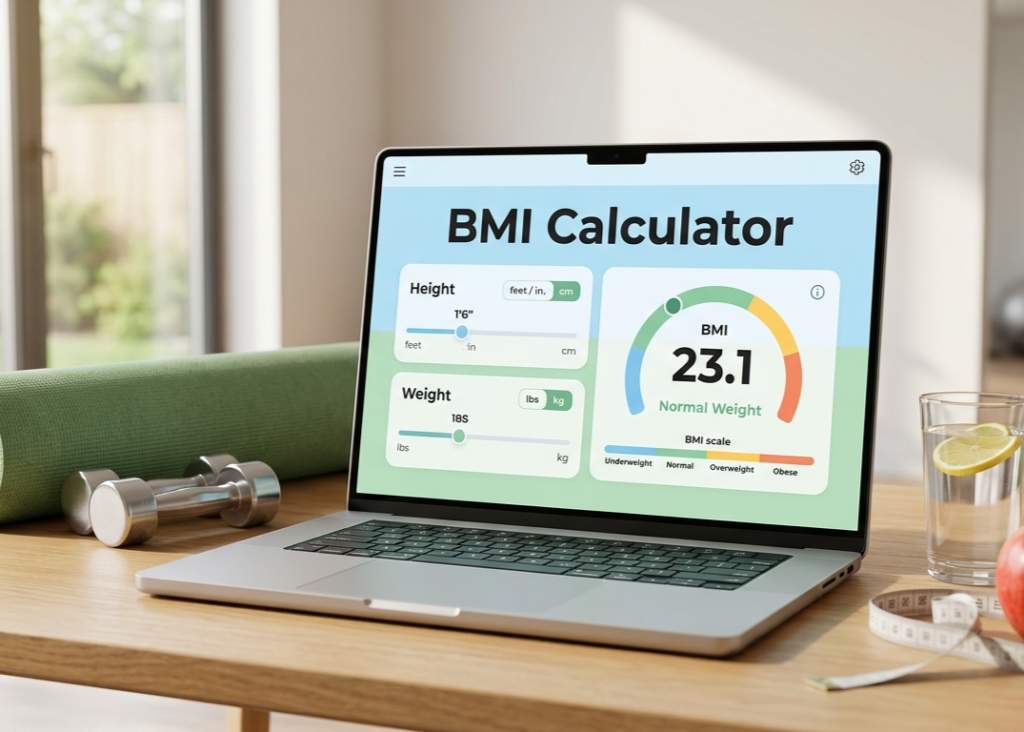
Using a modern online tool is incredibly simple. If you look at a premium dashboard interface—like the one displayed on the laptop screen in watermarked_img_978875470612670068.png—the entire process takes less than a minute. Here is exactly how to do it:
- Choose Your Unit System: Decide whether you want to input your data using the standard Metric system (centimeters and kilograms) or the Imperial system (feet/inches and pounds).
- Enter Your Height: Input your exact height. Accuracy matters here, so try not to round up or add an extra inch!
- Enter Your Weight: Type in your current weight. For the best baseline, weigh yourself in the morning before eating or drinking.
- Hit Calculate: The BMI calculator will instantaneously process your numbers and yield a single score alongside a visual color-coded breakdown.
Decoding Your BMI Score
Once the calculator spits out your final number, what does it actually mean? The World Health Organization (WHO) classifies adult BMI scores into four distinct categories.
You can use this reference table to evaluate your results:
| BMI Range | Weight Status | What It Indicates |
| Below 18.5 | Underweight | May indicate a need for nutritional adjustments or medical evaluation. |
| 18.5 – 24.9 | Normal Weight | Associated with the lowest risk of weight-related health conditions. |
| 25.0 – 29.9 | Overweight | May indicate an increased risk for cardiovascular strain. |
| 30.0 or Higher | Obese | Indicates a higher risk for chronic conditions like diabetes and hypertension. |
What a BMI Calculator Won’t Tell You
A Quick Reality Check: While a BMI calculator is an excellent, accessible starting point, it is a screening tool—not a flawless diagnostic crystal ball.
Because the mathematical formula only accounts for total weight relative to height, it treats all weight the same. It cannot differentiate between muscle mass, bone density, and body fat.
- Athletes and Bodybuilders: A highly muscular individual might register as “overweight” or “obese” on a basic BMI calculator, even though they have an exceptionally low body fat percentage. Muscle tissue is simply denser than fat tissue.
- Older Adults: As people age, they naturally lose muscle mass and bone density. An elderly individual might land perfectly in the “normal weight” category while still carrying an unhealthy ratio of visceral body fat.
Final Thoughts
Think of a BMI calculator as a helpful compass rather than a definitive roadmap. It is a fantastic, free tool to gauge where you sit on the general health spectrum. Use it to keep yourself accountable on your wellness journey, but always pair your results with other healthy habits—and a conversation with your doctor—to get the complete, accurate picture of your physical well-being.
- More Calcultator
- BMI Calculator